Educational Visualization Tool for Global Seismic Seismology

Standard

Incorporated Research Institutions for Seismology, IRIS, provides an educational visualization tool to aid in teaching about global seismology. Specifically it simulates how P-waves and S-waves travel from the epicenter on the surface of the Earth as well as through Earth’s interior.

It also provides annotations of each travelling ray as it reflects or refracts through the different layers along with their corresponding seismograms. Check it out here (opens in a new tab).

If you are a student, teacher, or just interested I invite you to check out the various learning and teaching resources available from IRIS.
Surprises at the Mariana backarc

Standard

The Mariana backarc, the same location of the deepest point on Earth, is where the thermal vents occur due to the spreading of two plates. In other words, the spreading apart of the sea floor results in a trench like the Mariana trench. At such backarcs, and the similar but not the same Mid-Ocean Ridges, “black smokers” form.

The following video is a fly-thru movie at the Mariana backarc in search for HydroThermal vents (second video).

Continue reading

Drilling Through Ice

Video

Two things drive us: pursuit of happiness and curiosity.

via Great Big Story

Vortex formation using a free jet

Standard

In a previous post I shared with you an image of milk vortices created in a hot coffee cup. Today I share with you a demonstration of vortex formation using a free jet of air of a speed higher than that (stagnant) surrounding it.

This is one case of fluid instability  called the Kelvin-Helmholtz instabilities (KHI) which occurs when two fluids have different velocities. A very popular and practical example of it are sea surface waves which are created due to the velocity difference between the water and wind.

More accurately, the shear force applied by one fluid (air in this case) on the other (water) creates a shear stress in the other fluid which if greater than the surface tension of the second fluid results in the KHI.

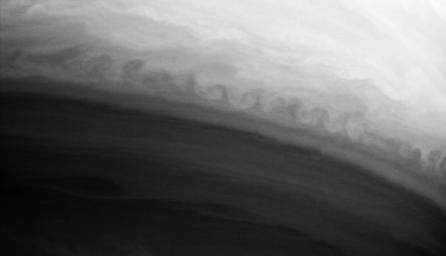
It is also common in clouds and on gas planets like Saturn and Jupiter as the following image of Saturn show.

Image credit: NASA/JPL/Space Science Institute

Four Days at Saturn – Cassini full-frame video

Standard