In a previous post we selected some resources on fluid dynamics. In that post we suggested the videos from the National Committe for Fluid Mechanics (notes on the website) that date to the 1960’s and is an excellent exposition to fluid mechanics. We share them below following a very clear demonstration of Euler’s equation and Bernoulli’s integral:
Fluid dynamics keep astonishing scientists. Every video or animation of a fluid dynamics experiment brings new information and provides stunning displays.
In a previous post I shared with you an image of milk vortices created in a hot coffee cup. Today I share with you a demonstration of vortex formation using a free jet of air of a speed higher than that (stagnant) surrounding it.
This is one case of fluid instability called the Kelvin-Helmholtz instabilities (KHI) which occurs when two fluids have different velocities. A very popular and practical example of it are sea surface waves which are created due to the velocity difference between the water and wind.
More accurately, the shear force applied by one fluid (air in this case) on the other (water) creates a shear stress in the other fluid which if greater than the surface tension of the second fluid results in the KHI.
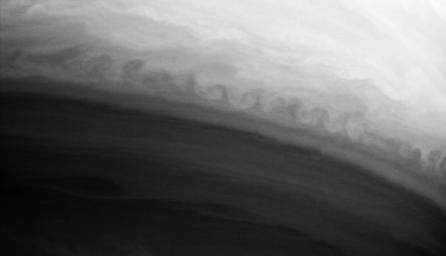
It is also common in clouds and on gas planets like Saturn and Jupiter as the following image of Saturn show.
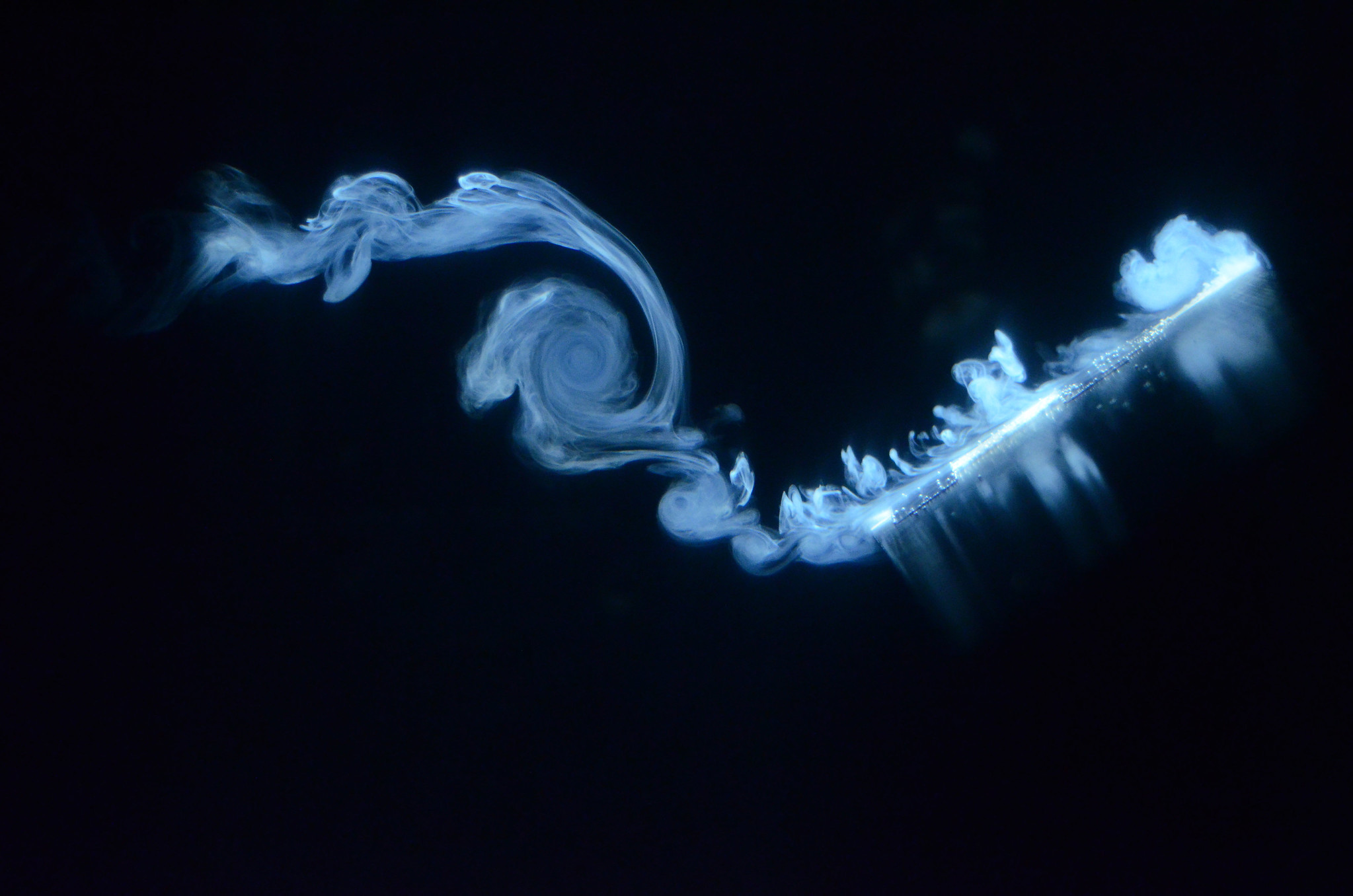
Robbie Stevens: Flat plate vortex formation at low Reynolds number
The Photograph shown is the raw image with no alterations. The image depicts a flat plate wing, which is simultaneously pitching and translating rapidly over a short distance through water at a Reynolds number of 10,000. This work is targeted towards understanding the aerodynamics of small insects with an intended application for Micro-Air Vehicles. The vortices are visualised by injecting a dye composed of milk and water. The milk has good reflective properties and is neutrally buoyant so follows the real flow faithfully. The inspiration for using milk came while pouring milk into a cup of tea at breakfast one morning! The photograph was taken by myself using a Nikon D7000 digital SLR camera, with the shutter speed and ISO adjusted to maximise the light entering the camera and allow the vortex structures to have a high contrast against the background. There are reflections of the vortex structures on the surface of the wing and some air bubbles are also visible on the dye injection needle on the wing’s surface.

 Ibrahim El Merehbi
You must be logged in to post a comment.