Lettuce Orbit Earth – A New Form of Life Takes Root on the ISS (Science@NASA)

Standard

The Human Brain project

Standard

The Human Brain Project (HBP)
The Blue Brain Project EPFL


If you enjoyed this post or found it useful please consider sharing it using the buttons below and supporting the blog using flattr or some bitcoins:

1BgwrNmtgWSth7KC67MZEbBhnsPshSb4x 1BgwrNmtgWSth7KC67MZEbBhnsPshSb4x


No Turning Back – West Antarctic Glaciers in Irreversible Decline (Science@NASA)

Video

“The glaciers contain enough ice to raise global sea levels by 1.2 meters.”


Summary extracted from transcript:
There’s enough water frozen in the ice sheet that feeds these icy giants to raise global sea levels by 4 feet (1.2 meters) if they were to melt. That’s troubling because the glaciers are melting.

Moreover, a new study finds that their decline appears to be irreversible.

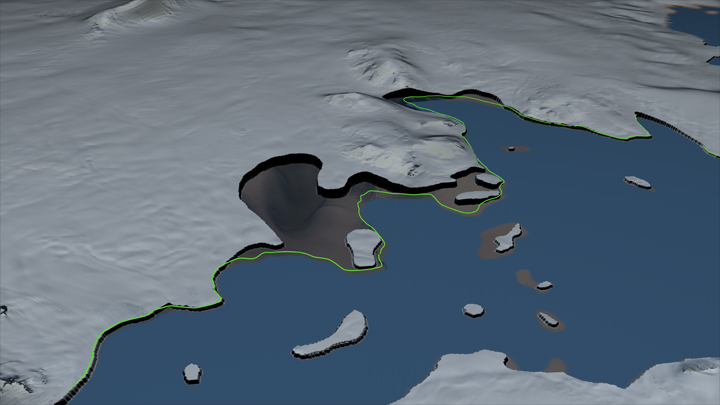
Rignot and colleagues have used 19 years ofsatelliteradardata to map the fast-melting glaciers.In their paper …theyconclude that ‘this sector of West Antarctica is undergoing a marine ice sheet instability thatwillsignificantly contribute to sea level rise’ in the centuries ahead.A key concept in theRignot study is the ‘grounding line’ the dividing line between land and water underneath a glacier.Because virtually all melting occurs where the glaciers’ undersides touch the ocean, pinpointing the grounding line is crucial for estimating melt rates.

In all the glaciers they studied, grounding lines were rapidly retreating away from the sea.
‘In this sector, we are seeing retreat rates that we don’t see anywhere else on Earth,’Rignot says.Smith Glacier’s line moved the fastest, retreating 22 miles upstream. The other lines retreated from 6 to 19 miles. As the glaciers melt and lose weight, they float off the land where they used to sit.Water gets underneath the glacier and pushes the grounding line inland. This, in turn, reduces friction between the glacier and its bed. The glacier speeds up, stretches out and thins, which drives the grounding line to retreat farther inland. This is a positive feedback loop that leads to out of control melting.‘At current melt rates,’ concludes Rignot, ‘these glaciers will be ‘history’ within a few hundred years.’

Here’s an image detailing the difference between the 1996 and 2011 grounding line:

A print resolution image showing the Smith Glacier and the adjacent ice shelves. Here the region covered by the ice shelves is colored blue. The white area shows where the glacier is over bedrock. The boundary traced by the green line shows the location of the grounding line in 1996. The edge of the white region indicates the location of the grounding line in 2011, which has retreated inland 35 km from the 1996 location. The area between the 1996 and 2011 grounding lines is shown as semi-transparent in order to view the depth of the valley beneath the glacier. source: NASA’s Scientific Visualization Studio

And this is an applet to see the difference yourself:

Source & Credit: NASA’s Scientific Visualization Studio – “West Antarctic Collapse

Wireless data transmitted through light bulbs [TED]

Standard

Below is a very interesting TED talk by Harald Haas from July 2011 on the use of light (and light detectors) to transmit digital data. I watched this video in August 2011 and just watched it again from my downloaded archive. This is really interesting.

It is worth noting, as Harald mentions, that data is transmitted as electromagnetic waves. And to those who are not aware light is an electromagnetic wave.

Enjoy

How should I best teach them? – Richard Feynman

Standard

In “The Pleasure Of Finding Things Out” Richard Feynman is asked the question of how should you best teach them?
All those students are in the class: Now you ask me how should I best teach them? Should I teach them from the point of view of the history of science, from the applications? My theory is that the best way to teach is to have no philosophy, [it] is to be chaotic and [to] confuse it in the sense that you use every possible way of doing it. That’s the only way I can see to answer it, so as to catch this guy or that guy on different hooks as you go along, [so] that during the time when the fellow who’s interested in history’s being bored by the abstract mathematics, on the other hand the fellow who likes the abstractions is being bored another time by the history—if you can do it so you don’t bore them all, all the time, perhaps you’re better off. I really don’t know how to do it. I don’t know how to answer this question of different kinds of minds with different kinds of interests—what hooks them on, what makes them interested, how you direct them to become interested. One way is by a kind of force, you have to pass this course, you have to take this examination. It’s a very effective way. Many people go through schools that way and it may be a more effective way. I’m sorry, after many, many years of trying to teach and trying all different kinds of methods, I really don’t know how to do it.