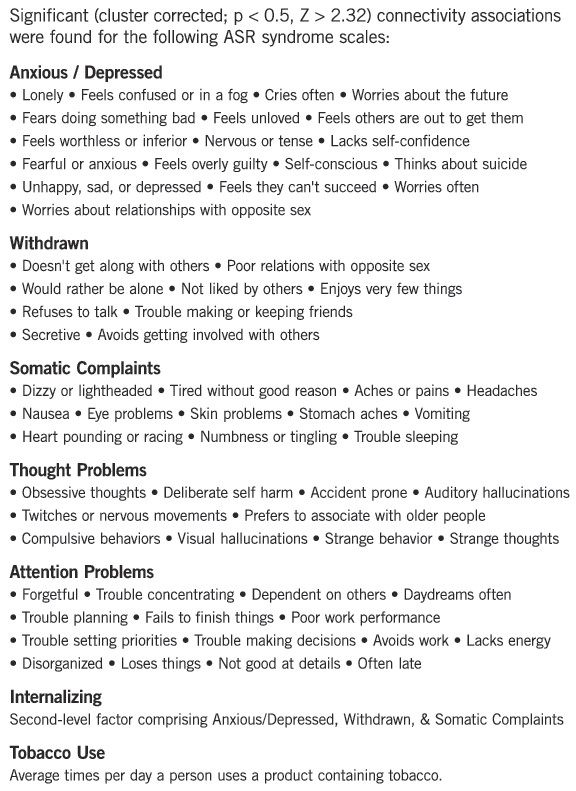
I found an interesting poster on brain connectivity associations of the ASR syndrome categorized by scales (depressed, stomach complaint, withdrawn, attention problems, thought problems, tobacco use, etc…) presented during the 2014 meeting of the Society of Biological Psychiatry (SOBP 2014) and wanted to share the graphic (2nd image) with you.
Since the school I currently teach at has not yet employed a Learning Management System (LMS) [1] or a School / Student Information System [2] that involves students (eg; in regard to assignments, worksheets, announcements, & grade book, etc…) and the students are expected to depend on their physical agenda which was not effective with some students, and since most students have a smartphone or access to a computer and an internet connection I started thinking of a way to solve this issue using technology.
Surely, I had to keep all students on equal footsteps especially for students who might be behind the class due to being slow writers or simply late because of being distracted.Continue reading
In “The Pleasure Of Finding Things Out” Richard Feynman is asked the question of how should you best teach them?
All those students are in the class: Now you ask me how should I best teach them? Should I teach them from the point of view of the history of science, from the applications? My theory is that the best way to teach is to have no philosophy, [it] is to be chaotic and [to] confuse it in the sense that you use every possible way of doing it. That’s the only way I can see to answer it, so as to catch this guy or that guy on different hooks as you go along, [so] that during the time when the fellow who’s interested in history’s being bored by the abstract mathematics, on the other hand the fellow who likes the abstractions is being bored another time by the history—if you can do it so you don’t bore them all, all the time, perhaps you’re better off. I really don’t know how to do it. I don’t know how to answer this question of different kinds of minds with different kinds of interests—what hooks them on, what makes them interested, how you direct them to become interested. One way is by a kind of force, you have to pass this course, you have to take this examination. It’s a very effective way. Many people go through schools that way and it may be a more effective way. I’m sorry, after many, many years of trying to teach and trying all different kinds of methods, I really don’t know how to do it.
To do high, real good physics work you do need absolutely solid lengths of time, so that when you’re putting ideas together which are vague and hard to remember, it’s very much like building a house of cards and each of the cards is shaky, and if you forget one of them the whole thing collapses again. You don’t know how you got there and you have to build them up again, and if you’re interrupted and kind of forget half the idea of how the cards went together—your cards being different-type parts of the ideas, ideas of different kinds that have to go together to build up the idea—the main point is, you put the stuff together, it’s quite a tower and it’s easy [for it] to slip, it needs a lot of concentration—that is, solid time to think—and if you’ve got a job in administrating anything like that, then you don’t have the solid time.So I have invented another myth for myself—that I’m irresponsible. I tell everybody, I don’t do anything. If anybody asks me to be on a committee to take care of admissions, no, I’m irresponsible, I don’t give a damn about the students—of course I give a damn about the students but I know that somebody else’ll do it—and I take the view, “Let George do it,” a view which you’re not supposed to take, okay, because that’s not right to do, but I do that because I like to do physics and I want to see if I can still do it, and so I’m selfish, okay? I want to do my physics.
You can find this between 08:22 – 09:56 of part 4 or or 38:16 – 39:52 of the full interview:
The interview is known as “The Pleasure Of Finding Things Out”. Here is the interview divided into 5 parts.




 1BgwrNmtgWSth7KC67MZEbBhnsPshSb4x
 Ibrahim El Merehbi
You must be logged in to post a comment.