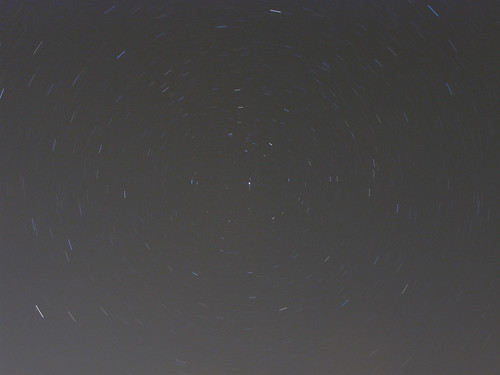
Dark Frame Subtraction & Light Pollution

Standard

This is not an article explaining what a dark frame is or how to take one or how to subtract it from an image. It is only to share with you a few test images I made lately (my first actually); I am not relating the two topics (i.e; dark frame subtraction with light pollution!):

No dark frame subtraction

With dark frame subtraction

Continue reading

Linux: What is it & why? (vids)

Standard

(Higgs) boson: Update from CERN

Standard

Some videos & links about the recent update regarding the (Higgs) boson:

“We know it is a new boson. But we still have to prove definitively that it is the one that Higgs predicted.”

“It’s a boson:” Higgs quest bears new particle [Reuters]


The Higgs Boson Explained from PHD Comics on Vimeo.
For more videos and comics by Jorge Cham and Daniel Whiteson, visit http://www.phdcomics.com/higgs

This video made with the support of the University of California at Irvine.

http://www.phdcomics.com

Others

Live-Blogging the Higgs Seminar

[vid] Higgs Boson announcement from Cern: as it happened

[vid] Press Conference: Update on the search for the Higgs boson at CERN on 4 July 2012

Imaging Techniques #1 – Scenic Images

Standard

This post is one of a series of short posts on the three main astroimaging techniques; scenic, afocal, and prime focus. This series is also part of a larger series on the fundamentals of astroimaging which are based on a presentation was preparing a while ago. For today I will introduce you to the first, the scenic image which you naturally take quite often. As a start here’s the definition of “scenic”:
Scenic: Of or pertaining to scenery; of the nature of scenery; theatrical [1913 Webster]
As the definition implies, such an image is one of people or anything in the foreground along with some natural scene in the background. By natural scene I mean a scene of nature; a scene with trees or mountains or land or the horizon or anything Earthly or a combination of those.

This imaging technique is a relatively easy to use as people do it all the time, naturally; all that it requires is some perception. I chose this this particular technique for this post since a very nice imaging opportunity [1] is coming soon which you could use to both learn this imaging technique and to take a nice astroimage with relative ease. All you need is your cam and your tripod (or use your imagination & skills to position the cam on a surface with the right angle & direction; for example you could use a table mount, or an inclined book). Continue reading

What is Computational Physics (Science)?

Standard

As a senior physics undergraduate I have come to believe that scientific computation must be part of the physics curriculum. It is true that physics students are required to study and master many topics, languages, techniques, and skills like mathematics, linguistics, & science communication, still I think that computational physics should be a major part of the curriculum. It is not logical to be in the age of supercomputers and the physics curriculum remain bound to pen and paper as it used to be before the advent of computers! I am not suggesting that physics should all be done on computers; absolutely not. The student must acquire the necessary theoretical and mathematical concepts and skills, besides the physics thinking, before delving in computational physics! What use would a computer have if its user doesn’t know what he wants to use it for? In other words, how would a physics student who hasn’t studied classical mechanics be able to solve a classical mechanics problem on a computer? He will surely not be able to do so, since he will not be able to appropriately instruct the computer due to his lack of conceptual physics and paper & pen problem solving skills. In short, “a computer is as dumb as its user is dump, and a computer is as smart as a smart user; the smarter and knowledgeable the user, the more productive and efficient the computer is”!

The computer is a little over 70 years old. The first computer, many articles & resources claim, is the “Electronic Numerical Integrator And Computer“, or ENIAC for short, which is not technically correct. Many other computers preceded ENIAC most of which were developed for military purposes (e.g; calculation of artillery, cryptoanalysis, etc…) and were analogue (or electro-mechanical) & programmed by punched cards. ENIAC was a room-sized computer that required several people to operate by turning on/off switches that made use of vacuum tubes the ancestor of the modern transistor.

One particularly interesting electromechanical machine (could be called a computer) was the “bombe” [1] which was [designed] by the mathematician Alan Turing to be used to crack the Enigma, the code used by the Nazi to encrypt messages.

Working rebuilt bombe at Bletchley Park [2].
Interior of the rebuilt bombe at Bletchley Park.
The bombe was in part successful in breaking the Enigma. Moreover, Alan Turing has impacted the modern day internet as well; everyone of us using the internet have definitely faced the “CAPTCHA” which are used to counter-bots & make sure the user is an actual human being & not a bot (from robot). CAPTCHA is an abbreviation for “Completely Automated Public Turing test to tell Computers and Humans Apart”. And yes, Turing in CAPTCHA is the same as Turing the mathematician of the 1940’s, though the original Turing test was a human against a machine test not the other way round!

Continue reading