Surprises at the Mariana backarc

Standard

The Mariana backarc, the same location of the deepest point on Earth, is where the thermal vents occur due to the spreading of two plates. In other words, the spreading apart of the sea floor results in a trench like the Mariana trench. At such backarcs, and the similar but not the same Mid-Ocean Ridges, “black smokers” form.

The following video is a fly-thru movie at the Mariana backarc in search for HydroThermal vents (second video).
Continue reading

Lab simulation of Strike-slip fault deformation using glass beads

Standard

via Strike-slip deformation with erosion and cross sections – The Field – AGU Blogosphere

Original post @ The Geo Models

Deepest part of the Ocean

Standard

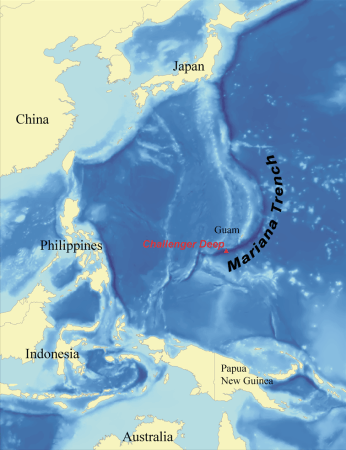
The deepest part in Earth’s oceanic crust is the Mariana Trench which is a located in the western Pacific ocean east of the Mariana islands near the Philippines and Japan. The trench is the location where two tectonic plates meet (converge), the pacific and Philippines plates. The Challenger Deep is its deepest point to which four descents have been made to. Its reaches a reaches a depth of about 11 km.

marianatrenchmap

Location of Challenger Deep in the Mariana Trench in the western pacific ocean.

Continue reading

Reading a Seismogram, a Funny & Illustrated Guide

Video

Computer Simulation of an Earthquake at the Hayward fault in California

Standard

An earthquake is the result of a sudden release of “strain” that is built-up between two tectonic boundaries or at a fault line*, usually slipping in opposite directions.

The following video by the California Academy of Sciences shows a computer simulation of an earthquake at the Hayward fault which is one and the most concerning of several faults in California. The most famous fault being the San Andreas fault.

via KQED Science

  • A fault is a fracture in the rocks of Earth’s crust. There three main categories of faults: Strike-slip, dip-slip, & Oblique-slip.