Best Practices for Scientific Computing

Standard

A summary of a very interesting paper on “Best Practices for Scientific Computing” I read a year ago.

Andrea Cirillo's avatarandrea cirillo's blog

I reproduce here below principles from the amazing paper Best Practices for Scientific Computing, published on 2012 by a group of US and UK professors. The main purpose of the paper is to “teach”  good programming habits shared from professional developers to people  that weren’t born developer, and became developers just for professional purposes.

Scientists spend an increasing amount of time building and using software. However, most scientists are never taught how to do this efficiently

Best Practices for Scientific Computing

  1. Write programs for people, not computers.

    1. a program should not require its readers to hold more than a handful of facts in memory at once
    2. names should be consistent, distinctive and meaningful
    3. code style and formatting should be consistent
    4. all aspects of software development should be broken down into tasks roughly an hour long
  2. Automate repetitive tasks.

    1. rely on the computer to repeat tasks
    2. save recent commands in…

View original post 226 more words
Update on the Rosetta (comet) mission

Standard

The Rosetta orbiter is continuing its science until the end of the extended Rosetta mission in September 2016. The lander’s future is less certain. This film covers some of what we’ve learnt from Philae about comet 67P/Churyumov-Gerasimenko so far.

This includes information about the comet’s surface structure from the ROsetta Lander Imaging System – or ROLIS camera – a copy of which can be found at the German Space Agency, DLR, in Berlin.

Data from all Philae’s instruments has informed the work of the other scientific teams. Rosetta scientists have analysed grains from the comet and discovered that it contains carbon rich molecules from the early formation of our solar system.

The video also contains footage from the Max Planck Institute for Solar System Research in Germany – where a flight replica of Philae’s COSAC instrument is maintained in a vacuum chamber to test commands. COSAC has already detected over a dozen molecules containing carbon, hydrogen, nitrogen and oxygen from the dust cloud kicked up from landing.

NASA’s JPL releases Two Math Libraries

Standard

NASA’s Jet Propulsion Laboratory (JPL) has released two large math libraries under an open source (BSD) license. Via Degenerate Conic:

“MATH77 is a library of Fortran 77 subroutines implementing various numerical algorithms. It was developed over decades at JPL, and contains some very high-quality and time-tested code. The code is released under a BSD-type license. There is also a C version for people who love semicolons.”

This goldmine includes basic mathematical functions, random number generators, linear algebra routines, solvers for systems of nonlinear equations, curve fitting, interpolation, and quadrature routines, and much more. The libraries are available at Netlib and are accompanied by 619 pages of detailed documentation.

[via jblevins.org]

Fortran Wiki

Map of Universities offering Data Science degrees

Standard

Below is a nice map created by Ali Rebaie of universities offering degrees in Data Science based on data from this github repo. Contribute using this Google spreadsheet.

[via Ali Rebaie]

Lebanon’s 2020 Digital Telecom Vision

Standard

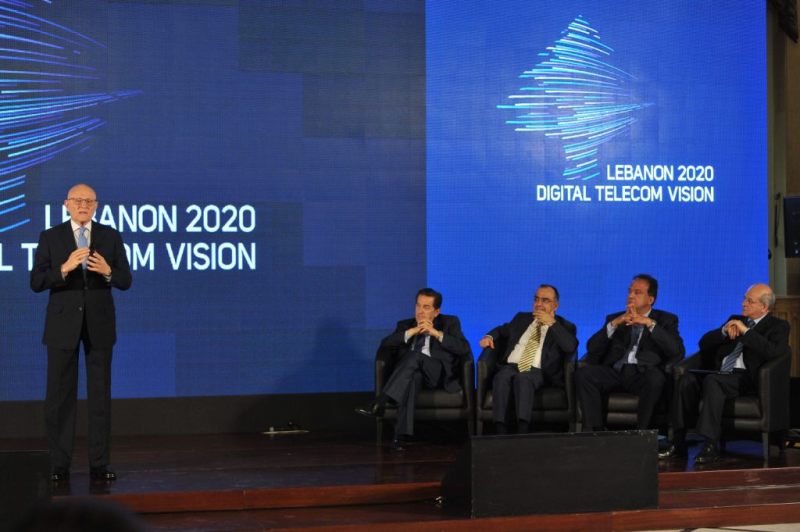
Earlier this month I was invited to attend the Lebanese Ministry of Telecommunications’s launching ceremony of its 2020 Digital Telecom Vision (لبنان ٢٠٢٠ رؤية الاتصالات الرقمية) which occurred on Wednesday July 1 2015 at the Grand Serail (ie; Governmental Palace).

Among the attendees were the Prime Minister Saeb Salam, Telecommunications Minister Boutros Harb, head of Ogero Abdel Moneim Youssef, and several others including tens of invited businessmen and technology experts.

Continue reading